


Home > Pharma & Food > Activated carbon
activated carbon
Activated carbon has the ability to adsorb odours. This is due to the porous properties of activated carbon and the adsorption process.
Porous structure
Activated carbon has an extremely porous structure with a large internal surface area. The activation process, in which carbon is treated at high temperatures with special gases, creates additional pores. This increases the effective surface area per gram of carbon.
Adsorption
The key mechanism by which activated carbon absorbs odours is adsorption. Gas and odour molecules bind to the surface of the activated carbon and are then no longer perceptible.
Physical attraction
Adhesion to the surface is caused by van der Waals forces. These forces ensure that odour particles are trapped in the pores and held there. No chemical bonds are involved.
Large surface area
The large surface area of activated carbon makes it possible to adsorb a considerable amount of odour molecules. This removes unpleasant odours from the air.
Regeneration
Activated carbon can be regenerated by heating it. The absorbed molecules are then desorbed. This process removes the odour substances from the activated carbon and makes it ready for use again.
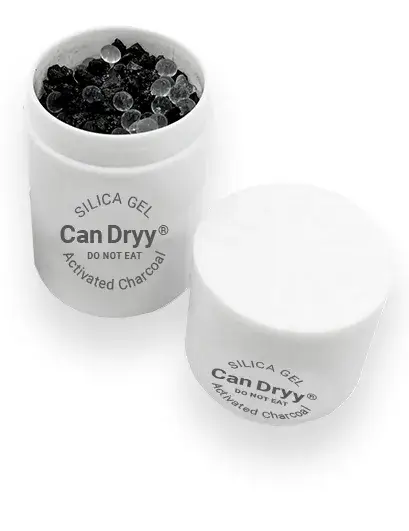
Activated carbon’s ability to adsorb odours makes it an effective and versatile material for air purification. This means that an activated carbon product can absorb unwanted odours within packaging, for example from fish oil capsules.
Application in combination with silica gel
Combining activated carbon and silica gel in products such as desiccants, air fresheners and other odour eliminators offers a synergistic effect, as both materials have different properties. Activated carbon is particularly effective at adsorbing gases and odours. Silica gel, on the other hand, is an excellent desiccant that can adsorb moisture from the air. This is especially useful in environments where both moisture and odours are a problem—for example, with outgassing substances in medical devices that also need to be protected from excessive humidity so they do not lose their effectiveness.