


A manufacturer of modular prefabricated bathrooms approached ThoMar to explore ways of preventing moisture damage. The concrete bathrooms are completely fitted with tiles, sanitary facilities and all pipe connections for later installation at the factory. Interim storage in the factory before delivery and/or before installation of the modules, e.g. in retirement homes, on the construction site can take several weeks or even months, depending on the project. In the past, this has resulted in mildew stains or even mold growth in the bathrooms.
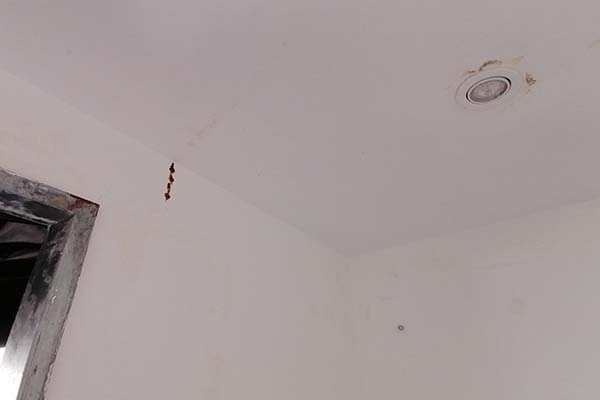
Image: Moisture damage to the wall and ceiling of the concrete modules
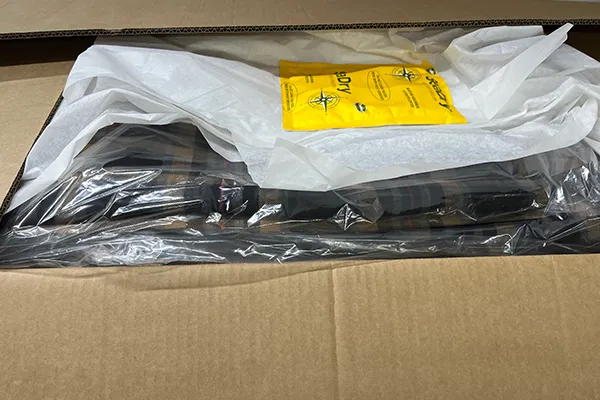
After several discussions and a detailed analysis of the situation, ThoMar OHG offered to carry out a test together with the customer with a total of five prefabricated baths to be equipped with desiccants. In this application, the challenge lay on the one hand in the product properties of the concrete (moisture content and release over time), and on the other hand in the temperature fluctuations (which always favor condensation in an enclosed space), which in turn influenced the moisture release of the concrete during storage. Due to the demanding conditions, the choice fell on the high-performance desiccant SeaDry in the Blanket variant. This was originally developed specifically for weeks of use in container transportation at sea and can absorb correspondingly large amounts of moisture.
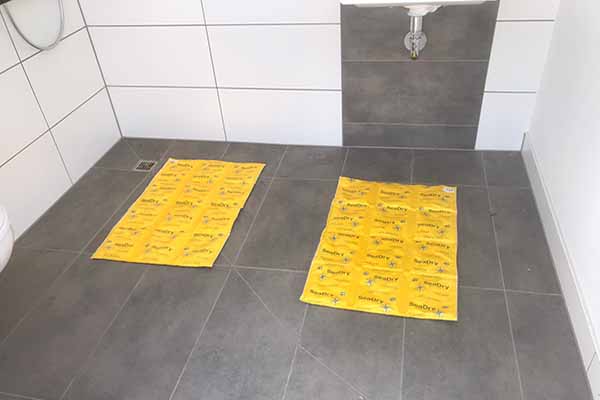
Image: SeaDry container desiccants are placed in the modules.
The evaluation after the two-month test period (September to November) showed a temperature range of minus 7 to plus 38 degrees Celcius. The three SeaDry Blankets used per bath absorbed an average of around 9 liters of water in total.
Important notes:
The use of SeaDry products is only suitable for reducing humidity in a closed environment and is not intended to absorb water that enters the room to be protected from outside in an uncontrolled manner, e.g. in the form of rainwater. The room must be sealed as well as possible and the degree of saturation of the desiccant must be monitored. Without these measures, optimum effectiveness of the desiccants and thus the achievement of a non-critical relative humidity cannot be guaranteed.
The effectiveness of SeaDry is reduced during periods of strong temperature fluctuations in conjunction with a humid climate (earlier saturation – replacement necessary). The intervals for checking and replacing the desiccant can be found in the following table.
| Season | Test interval | Replacement interval |
| Spring | 4-6 weeks | after 8 weeks at the latest |
| Summer | 6-8 weeks | after 9 weeks at the latest |
| Autumn | 4-5 weeks | after 6 weeks at the latest |
| Winter | 3-4 weeks | after 5 weeks at the latest |
Table: Recommendation specifically for storage of concrete modules in Central European climates